The relationship between a vehicle and the surface it travels on is a dynamic interaction that dictates fuel efficiency, handling precision, ride comfort, and component longevity. While drivers often focus on engine maintenance and oil changes, the quality of the roadway plays an equally critical role in how a car performs. From pristine highways to severely degraded city streets, varying road surfaces exert unique physical forces on a vehicle’s mechanical systems, particularly its tires and suspension. Understanding how these diverse conditions impact a vehicle allows drivers to anticipate mechanical wear, maximize fuel economy, and maintain optimal safety.
The Physical Link Between Road Surfaces and Vehicle Metrics
The entire operating capability of a vehicle rests on four small patches of rubber known as the tire contact patch. The characteristics of the driving surface dictate how effectively these contact patches can transfer engine power and braking forces to the ground.
When a vehicle travels over rough or unpaved surfaces, the mechanical resistance increases. This resistance, known as rolling resistance, forces the engine to work harder to maintain a constant speed. On poorly maintained roads or gravel tracks, rolling resistance escalates drastically. The engine consumes more fuel to overcome this resistance, which directly lowers the vehicle’s fuel efficiency.
Furthermore, rough road surfaces alter the behavior of a vehicle’s suspension system. Springs, struts, and shock absorbers must work continuously to damp the vibrations caused by uneven terrain. When the suspension is forced into constant motion by a degraded roadway, the vehicle loses a degree of handling precision. Body roll increases, steering feedback becomes less predictable, and the overall stability of the automobile is compromised, especially during high-speed cornering or sudden braking maneuvers.
Potholes and Deformed Asphalt: The Mechanics of Structural Stress
Potholes represent one of the most severe hazards that a vehicle can encounter on a standard roadway. Formed by the expansion and contraction of ground water combined with heavy traffic weight, these structural failures in the asphalt cause immediate and long-term damage to multiple vehicle components.
Accelerated Tire Degradation and Failures
Impacting a pothole at high speed compresses the tire carcass between the wheel rim and the hard edge of the crater. This compression can slice through the internal fabric and steel belts of the tire, leading to an immediate blowout.
Even if the tire does not deflate instantly, the internal structure may be permanently compromised. This often manifests as a bubble or bulge on the sidewall, indicating that the inner liner has torn and air is pushing against the outer rubber layer. Such tires are highly susceptible to catastrophic failure and must be replaced immediately.
Suspension and Wheel Misalignment
The violent vertical force of a pothole impact transfers directly into the suspension geometry. Control arms can bend, ball joints can loosen, and shock absorbers can leak or rupture.
Most frequently, these impacts knock the vehicle out of alignment. Misalignment alters the angles of the tires relative to each other and the road surface, specifically affecting the toe, camber, and caster settings. When a vehicle is misaligned, the tires no longer roll flat against the pavement, causing rapid, uneven tread wear and forcing the vehicle to pull to one side.
The Impact of Varying Road Materials on Tire Wear
Not all paved roads are created equal. The specific aggregate mixes used in road construction create distinct textures that influence how quickly tire tread degrades over time.
Coarse Chip-Seal Surfaces
Chip-seal is a common pavement surface created by spraying an asphalt emulsion onto the road and covering it with a layer of crushed aggregate or stone chips. While cost-effective for municipalities, chip-seal creates a highly abrasive surface. The sharp, exposed edges of the stone chips act like coarse sandpaper on tire tread. Constant driving on chip-seal roads accelerates uniform tread wear, shortening the overall lifespan of the tire and increasing cabin noise due to the high frequency of tire-to-pavement friction.
Smooth Asphalt versus Rigid Concrete
Standard smooth asphalt provides a balanced compromise between grip and low tire wear. However, open-graded friction courses used on major highways have a more porous structure designed to drain water, which can slightly increase tire wear compared to dense asphalt.
Concrete highways, frequently chosen for their structural longevity, often feature longitudinal or transverse grooves to channel water away. These grooves can cause a phenomenon known as tire squirm, where the tire tread blocks flex excessively as they follow the grooves, leading to specialized wear patterns and a distinct humming sound inside the vehicle cabin.
Environmental Elements and Wet Roadways
Weather conditions continuously transform the nature of any road surface, fundamentally altering the coefficient of friction between the tire rubber and the pavement.
Standing Water and Hydroplaning
When rain accumulates on a roadway, the tire tread must displace the water to maintain direct contact with the pavement. Tires feature intricate grooves designed specifically to channel water away from the contact patch.
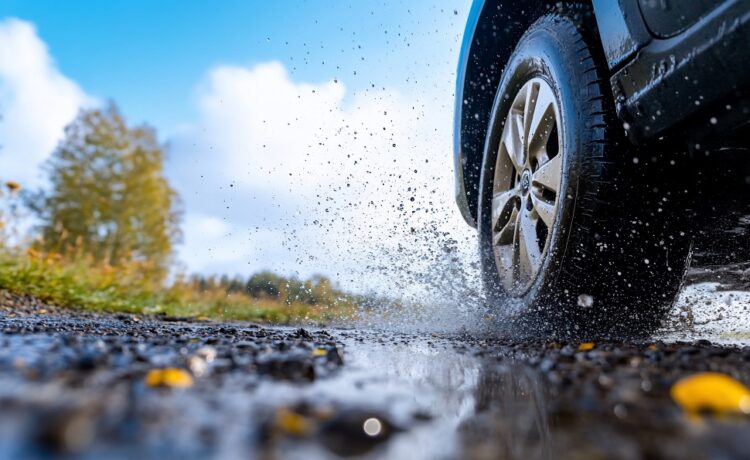
If the volume of water exceeds the tire’s evacuation capacity, or if the tread depth is insufficient, a wedge of water builds up ahead of the tire. The tire can lift entirely off the pavement and float on a thin film of water, a dangerous condition known as hydroplaning. During hydroplaning, traction drops to near zero, rendering steering and braking completely ineffective.
Chemical Contamination and Slippery Surfaces
The initial phase of a rainstorm is often the most hazardous. Before the rain is heavy enough to wash the road clean, the water mixes with accumulated engine oil, grease, and fuel residue on the asphalt surface. This creates a highly lubricated, slick film that severely reduces vehicle traction.
Furthermore, during winter months, roads treated with salt, brine, or chemical de-icers can suffer accelerated surface pitting. These chemicals also coat tires in a residue that can mask minor tread cracks, making regular visual inspections more difficult for vehicle owners.
Unpaved Roads: Gravel, Dirt, and Debris
Driving on unpaved surfaces presents a completely different set of physical challenges for an automobile. Gravel and dirt roads lack the cohesive structural binding of asphalt or concrete, leading to constant surface shifting under the weight of a vehicle.
Tread Chipping and Stone Retention
Gravel roads are comprised of loose, loose-edged rocks. As tires roll over these stones, the tread blocks can suffer from chipping and tearing, where small pieces of the rubber compound are physically torn away from the tire body.
Additionally, small pebbles can become securely wedged into the tread grooves. This stone retention can cause long-term damage; as the tire rotates, the trapped stone is continually pressed deeper into the groove, eventually puncturing the protective rubber layer and exposing the underlying steel belts to moisture and corrosion.
Washboarding and Constant Vibration
Unpaved roads frequently develop a wavy pattern known as washboarding or corrugation. This ripple effect is caused by the regular movement of vehicles accelerating and braking over the loose material.
Driving over a washboard road subjects a vehicle to high-frequency, low-amplitude vibrations. This constant rattling vibrates fasteners loose, stresses electronic connections, and places immense thermal strain on the shock absorbers, which can overheat as they attempt to dissipate the continuous energy input.
Frequently Asked Questions
What is the specific pattern of tire wear caused by driving on misaligned wheels?
Wheel misalignment typically manifests as feathering or one-sided tread wear. Feathering occurs when the tread blocks wear down smoothly on one side but remain sharp on the other, usually caused by incorrect toe alignment. One-sided wear occurs when either the inner or outer edge of the tire tread wears down significantly faster than the rest of the tire, which is a classic symptom of incorrect camber alignment resulting from suspension sagging or pothole impacts.
How does driving on unpaved gravel roads affect a vehicle’s braking distance?
Braking distances increase significantly on gravel roads compared to dry asphalt. Because the surface layer consists of loose stones, the tire cannot establish a firm mechanical grip on a solid foundation. Instead, the stones slide over one another under the force of braking. Even with modern anti-lock braking systems, the vehicle will slide further because the rolling aggregate under the tire acts like ball bearings, reducing the effective coefficient of friction.
Why do some highway surfaces cause a vehicle to wander or pull slightly without a crosswind?
This behavior is often caused by a road condition known as rutting. Ruts are longitudinal depressions formed in the wheel paths of asphalt roads, usually created by heavy commercial trucks deforming the pavement over time. When a passenger vehicle drives within or across these ruts, the tires naturally try to climb the sides of the depression or drop into the lowest point, creating a tramlining effect that makes the steering wheel feel like it is pulling or wandering.
How does low tire pressure exacerbate the damage caused by poor road conditions?
When a tire is underinflated, it lacks the internal pneumatic pressure required to maintain its structural shape under load. If an underinflated tire hits a pothole or a sharp bump, the sidewall flexes excessively, allowing the wheel rim to smash completely through the thin cushion of air and strike the inner tire liner against the pavement. This increases the likelihood of a pinch shock, which tears the internal plies and causes immediate sidewall bubbles or catastrophic blowouts.
Can driving on rough city streets accelerate the wear of engine and transmission mounts?
Yes, continuous driving on rough, poorly maintained city streets can cause premature failure of engine and transmission mounts. These mounts consist of rubber blocks bonded to metal brackets, designed to isolate the vehicle cabin from powertrain vibrations. When a vehicle constantly bounces over potholes, sunken utility covers, and cobblestones, the mounts are subjected to severe, repetitive vertical forces that can tear the rubber or separate it from the metal brackets, leading to engine shifting and cabin vibration.
How do concrete expansion joints impact long-term vehicle health?
Concrete expansion joints are gaps placed between concrete highway slabs to allow for thermal expansion. While necessary for the infrastructure, driving over these joints at high speeds creates a repetitive thumping force. This continuous rhythmic impact puts a steady strain on the vehicle’s wheel bearings, steering rack, and interior trim panels. Over time, it can cause wheel bearings to develop flat spots and interior cabin panels to develop annoying squeaks and rattles due to the loosening of plastic clips.
Does the temperature of the road surface affect how fast tire tread wears away?
Road surface temperature has a major impact on tread wear rates. On hot summer days, asphalt can reach temperatures far higher than the ambient air temperature. This extreme heat softens the rubber compounds in a tire, making the material more compliant and highly susceptible to rapid abrasive wear. When combined with the high friction of a coarse road surface, hot pavement significantly accelerates the rate at which rubber particles are scraped away from the tire tread.